
Montgomery County Property Tax Records
Montgomery County property tax records are maintained by the County Assessor and Circuit Clerk in Mount Ida, Arkansas. These records cover real property assessments, personal property filings, tax bills, and delinquent accounts across the county. Whether you need current values or historical data going back to the 1800s, this guide walks you through the key offices, online tools, and filing deadlines that apply to Montgomery County property owners.
Montgomery County Property Tax Overview
Montgomery County Assessor
The Montgomery County Assessor's office in Mount Ida handles all real and personal property assessments in the county. The assessor can be reached at (870) 867-3271. Under Arkansas Code Annotated § 26-26-1101, property owners must assess real property each year between January 1 and July 31. Personal property assessments follow a slightly tighter window — January 1 through May 31 — as set out in § 26-26-1408. If you miss that personal property deadline, a 10% late penalty applies.
All taxable property in Montgomery County is valued as of January 1 each year, consistent with § 26-26-1201. The assessed value equals 20% of the market value your assessor determines. So a property worth $150,000 on the open market carries an assessed value of $30,000 for tax purposes. That 20% rate is fixed statewide — it doesn't vary from county to county. What varies is the millage rate each local taxing unit sets, which then multiplies against the assessed value to produce your actual tax bill.
Montgomery County also has historical assessment records that predate modern electronic systems. The county's historical records include persons and personal property assessed from 1865 to 1894, plus county court records from 1845 to 1880. These older documents can matter if you're tracing a chain of title or doing genealogical research. The assessor's office or the Circuit Clerk can help point you to those records.
Online Property Search Tools
The fastest way to look up Montgomery County property data is through ActDataScout's Montgomery County portal. This tool lets you search by owner name, parcel number, or property address. Results include assessed values, ownership history, and in many cases tax payment status. The site is free to use for basic lookups.
The ActDataScout platform pulls from county assessor records and updates regularly, so values generally reflect the current assessment year. You can also try ARCountyData.com, a statewide property search tool that aggregates data from Arkansas county assessors. Both tools work well for getting a quick snapshot of a parcel's assessed value, owner of record, and legal description. Neither replaces official certified copies from the Circuit Clerk, but they're a solid starting point.
For the most current and complete information, visit the assessor's office in person at the Montgomery County Courthouse in Mount Ida.
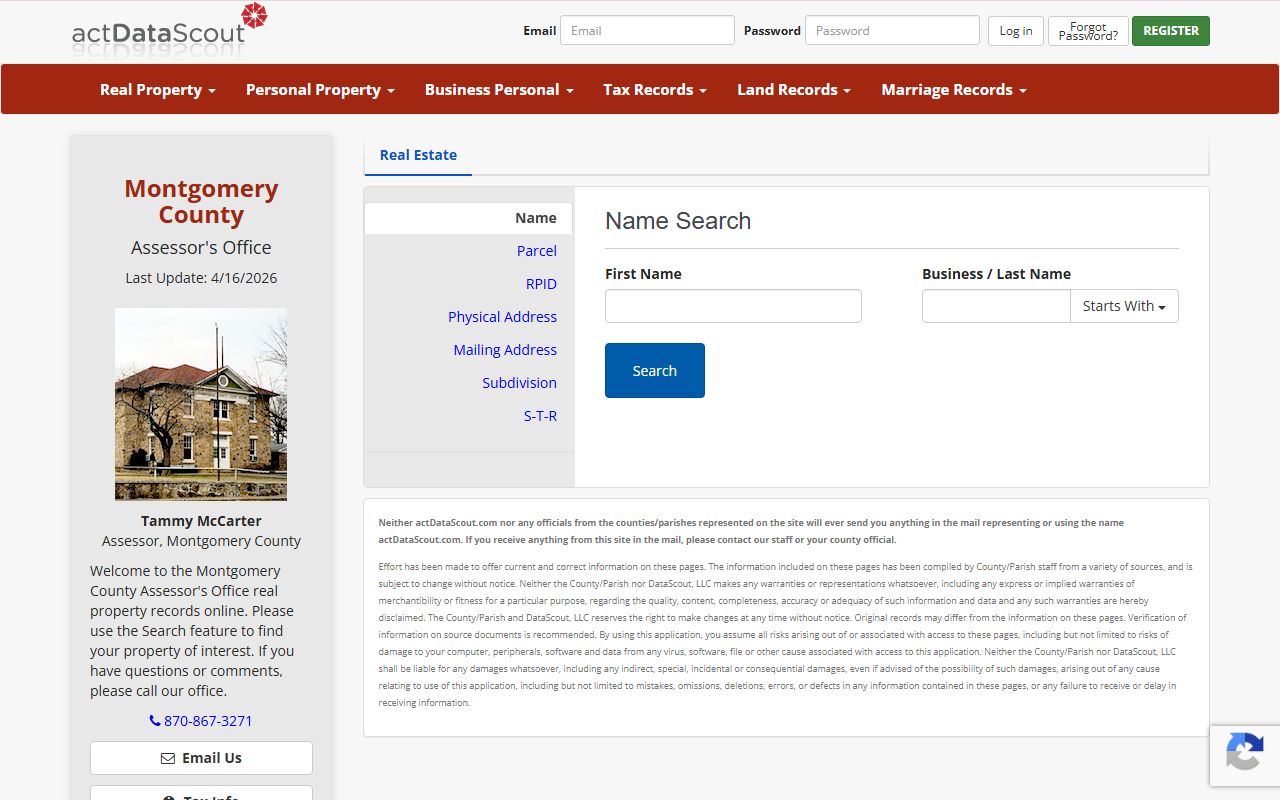
The Montgomery County ActDataScout page is shown below.
How Property Assessment Works
Every few years, the Montgomery County Assessor conducts a full reappraisal of all real property. Arkansas law requires counties to reappraise on a cycle of three to five years. That process involves comparing recent sales, reviewing property condition, and updating values to reflect market changes. Between full reappraisals, values generally hold steady unless you add improvements or the property changes hands.
Amendment 79 to the Arkansas Constitution provides some protection for homeowners. Under this provision, the assessed value of a homestead cannot increase by more than 5% in any given year, and the total increase over five years cannot exceed 10%. This cap applies only to properties that are owner-occupied as a primary residence. Investment properties and commercial real estate don't get the same protection. If your property qualifies, the cap takes effect automatically — you don't need to file a separate application for it.
You do need to file separately for the homestead tax credit under Amendment 79. That credit can reduce your tax bill by up to $375 per year. You must own and occupy the property as your primary home, and you must file with the assessor's office. The deadline to claim the credit for a given tax year is October 15. Older property owners and those with qualifying disabilities may be eligible for a freeze on their assessed value — meaning even if the market moves, the value used to calculate their taxes stays flat.
Tax Collection and Deadlines
Property tax bills in Montgomery County go out around July 1 each year. The payment deadline is October 15, as established in Arkansas Code § 26-35-501. Pay by that date and you're done. Miss it and interest and penalties begin to accrue. The county collector posts a delinquent list on December 1 showing all properties with unpaid taxes.
If a property stays delinquent, the state can eventually move to collect it through the Commissioner of State Lands. Under § 26-37-101, land with at least one year of unpaid taxes can be certified to the state. Once certified, the owner has a limited window to redeem the property by paying all back taxes, interest, and fees. After that window closes, the state can sell the property. You can check the status of tax-delinquent properties in Montgomery County through the Commissioner of State Lands website.
Most people pay on time. But it's worth knowing the rules in case you're buying a property with a complicated history or dealing with an estate.
Circuit Clerk and Recorded Documents
The Montgomery County Circuit Clerk's office handles recorded real property documents — deeds, mortgages, liens, and similar instruments. The Circuit Clerk can be reached at (870) 867-6701. This office maintains the official chain of title for all land in Montgomery County. When you buy property, the deed gets filed here. When a lender places a lien, that document goes here too.
Certified copies of recorded documents cost $15 for the first page and $5 for each additional page. Documents must be on 8.5x11 paper with a 2.5-inch top margin and 0.5-inch side margins. These formatting requirements apply to documents submitted for recording. When you request copies, the clerk's office handles the reproduction and certifies them as true copies of the original filed record.
For title research, you'll want to search both the assessor's records and the Circuit Clerk's index. The assessor tracks values and ownership for tax purposes; the Circuit Clerk maintains the legal record of title transfers and encumbrances. Both are essential if you're doing a full title search. The Arkansas Association of Counties has additional guidance on how county offices work together to manage property records.
Delinquent Tax Properties and State Resources
When Montgomery County property taxes go unpaid long enough, the property gets certified to the Arkansas Commissioner of State Lands. The COSL office then manages the redemption and sale process. If you're interested in purchasing tax-delinquent land in Montgomery County, the COSL website lists available properties and explains the process for making an offer or attending an auction. This can be a way to acquire rural or vacant land, though you should research any property carefully before bidding.
The Arkansas Assessment Coordination Division provides oversight and guidance to county assessors across the state. You can find information about assessment standards, reappraisal cycles, and property tax law through the Arkansas DFA Assessment Coordination Division. This office doesn't handle individual county records, but it's a useful resource if you have questions about how your assessment was calculated or what standards the county must follow.
Nearby Counties
Montgomery County borders several other Arkansas counties, each with its own assessor and property records system.