
Find Arkansas Property Tax Records
Arkansas property tax records are public documents held at the county level across all 75 counties. Each County Assessor maintains assessed values, ownership data, and property characteristics, while the County Collector handles tax bills and payment history. You can search Arkansas property tax records online through statewide portals, contact your county offices directly, or visit the courthouse in person. This guide covers where to find records, how the assessment system works, key deadlines, and what tools are available to search property tax data across the state.
Arkansas Property Tax Records Overview
How Arkansas Property Tax Records Work
Property taxes in Arkansas are levied by all 75 counties, 502 municipalities, and 239 school districts. Assessment happens at the county level. Real property like land, buildings, homes, and barns that is not tax-exempt gets assessed at 20 percent of true market value under state law. Personal property such as vehicles, boats, and livestock is also assessed at 20 percent of usual selling price at the time of assessment. Arkansas is one of the least property tax-reliant states in the country. The median real estate tax paid on owner-occupied homes here runs about $647, compared to the national median near $2,107.
The Arkansas Assessment Coordination Division (ACD) is the state agency that oversees property tax administration for all 75 counties. The ACD has full authority over valuation, assessment, and equalization of all property for ad valorem tax purposes. It prepares assessment manuals for county assessors, conducts annual ratio studies to check quality, visits county offices, and helps distribute state funds for reappraisal work. Every county must complete a real estate reappraisal on a three or five year cycle, and the ACD audits that process to ensure fair and consistent results across the state.
Arkansas property tax records include far more than just a tax bill. Each county assessor keeps property record cards that show parcel numbers, ownership history, legal descriptions, sale prices, building characteristics, and the current assessed value. This data is the foundation for all tax calculations. When a property is sold, the Circuit Clerk records the deed, and the assessor updates the ownership information. The record card follows the parcel through changes in ownership, improvements, and reappraisals over time.
How to Search Arkansas Property Tax Records Online
Two main platforms let you search Arkansas property tax records online at no charge. Both are used by county offices across the state and provide reliable, updated data on assessments, ownership, sales history, and tax status.
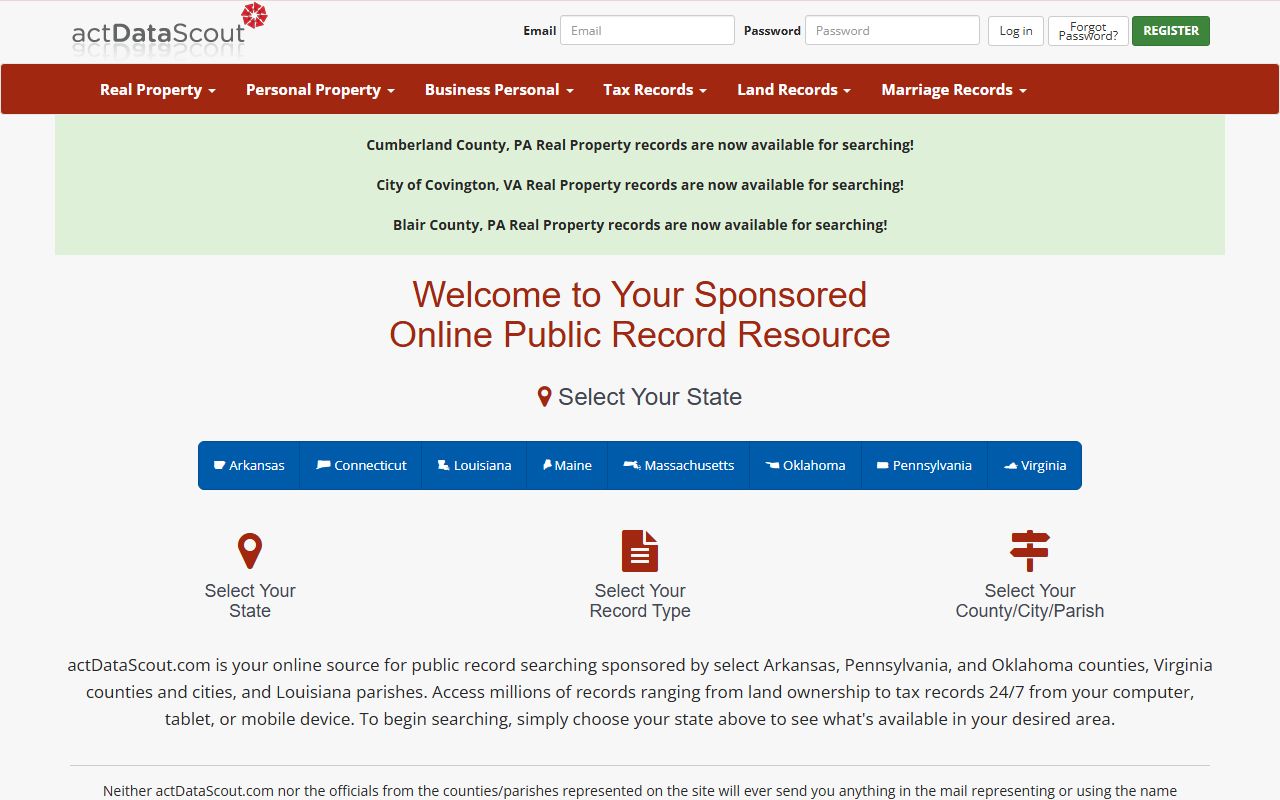
ActDataScout is the primary online portal for Arkansas property records. Many county assessors use it as their official public search tool. You can search by owner name, property address, parcel number, or legal description. Results include ownership information, assessed values, building characteristics, sales history, and tax payment status. The platform runs 24 hours a day and is free for basic searches. County-specific pages are available at actdatascout.com for each participating county.
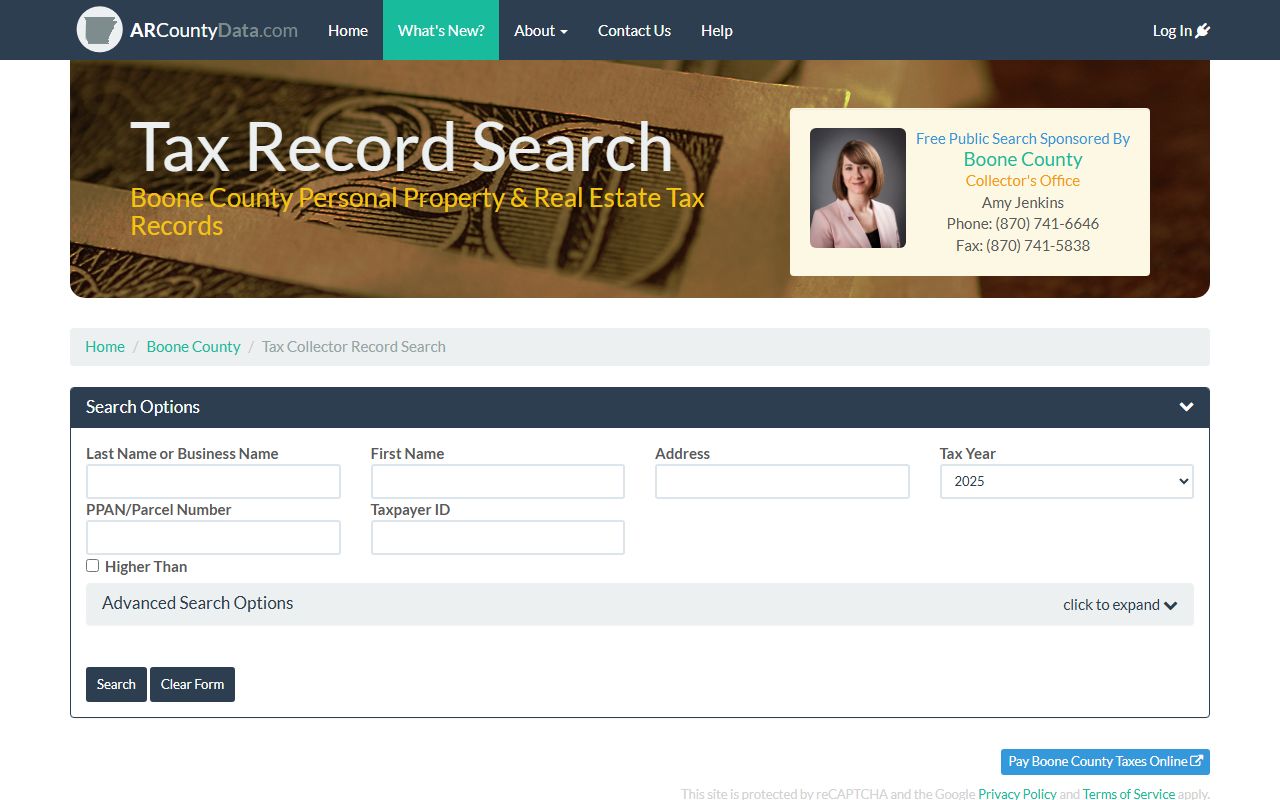
ARCountyData is the second major statewide property search platform. County tax collectors across Arkansas sponsor free public searches through this system. Users can search property assessments by parcel number, owner name, or address and view sales histories, building descriptions, legal descriptions, and payment information. Records update on a monthly basis in most participating counties. Both platforms cover most of the 75 Arkansas counties, so if your county isn't on one, try the other.

The Arkansas Geographic Information Office (AGIC) also maintains GIS parcel data through the GeoStor portal. You can download county parcel layers at no charge using the keyword search "CAMP" to locate the County Assessor Mapping Program data. This includes both parcel centroid points and polygon boundary layers for all Arkansas counties. It's useful for spatial research or for verifying property boundaries on a map.
The County Assessor and Property Assessment
The County Assessor is the local official responsible for discovering, listing, and valuing all taxable property in the county. Under A.C.A. § 26-26-1101, the assessor must appraise and assess all real property between the first Monday in January and July 1 each year. All properties in the county get assessed according to their value on January 1 of the assessment year, per A.C.A. § 26-26-1201.
For personal property like vehicles, boats, ATVs, and livestock, taxpayers must file an assessment with their county assessor between January 1 and May 31 each year. Under A.C.A. § 26-26-1408, a 10 percent penalty applies for late assessment. You can assess personal property by mail, phone, online, or in person at the assessor's office. Most assessors accept phone assessments without requiring written verification under oath. The assessor sends a mail confirmation within five business days of any phone assessment.
Every Arkansas county conducts a countywide reappraisal of all real property on a three to five year cycle. The ACD assists with the reappraisal plan and uses state funds to help cover the cost. Between reappraisals, Amendment 79 of the Arkansas Constitution caps increases in taxable assessed value at 5 percent per year for homesteads and 10 percent per year for non-homestead real property. New construction is added to the roll each year at current market value.
Property Tax Collection in Arkansas
The County Collector handles property tax billing and payment. Tax bills go out by July 1 each year. Under A.C.A. § 26-35-501, taxes are due October 15. Pay by that date to avoid penalties and interest. Most counties accept payments in person, by mail, or online during the collection period.
County millage limits cap how much each taxing unit can levy. Counties may levy up to 21 mills total, broken down as 5 mills for general government operations that the quorum court can levy without voter approval, 5 mills for bonded debt requiring voter approval, 5 mills for library maintenance and operation, 3 mills for library capital improvements, and 3 mills for county roads. Cities can levy up to 20 mills for various purposes. School districts have no maximum but must meet a minimum of 25 mills under Amendment 74. The county quorum court formally sets millage rates at its November meeting each year, and those rates apply to taxes collected the following year.
The Arkansas Association of Counties maintains collector resources and answers to common questions about property tax collection. Their site covers topics like how taxes are calculated, what happens when taxes go unpaid, and how the tax sale process works. It's a good resource if you have questions about the collection side of property taxes in Arkansas.

Homestead Credit and Property Tax Relief
Amendment 79 of the Arkansas Constitution provides meaningful tax relief for homeowners. The amendment gives an up to $600 homestead credit on property taxes for a property owner's principal place of residence. To get the credit, you apply through your county assessor's office. The deadline to apply is October 15 each year. Once a deed is filed with the Circuit Clerk, the assessor sends a homestead credit form to the new owner automatically.
Amendment 79 also lets homeowners who are 65 or older, or totally disabled, freeze the taxable value of their principal residence. This means the assessed value for tax purposes won't go up even if the property's market value rises. The freeze applies only to the homestead. Separate or investment properties don't qualify. The 5 percent annual cap on homestead assessment increases also applies to all qualifying homesteads regardless of age or disability status. These protections were approved in the 2000 general election and remain some of the strongest homestead protections in the region.
Note: Apply for the homestead credit at your county assessor's office by October 15. Senior and disabled homeowners can also apply for a taxable value freeze at the same office.
Tax Delinquent Property and State Land Sales
When property taxes go unpaid for one year past the due date, the land becomes eligible for certification to the state. Under A.C.A. § 26-37-101, all lands with taxes unpaid for one year after the due date are forfeited to the state and transmitted by the county collector to the Commissioner of State Lands. The county collector must publish delinquent tax lists in a local newspaper by December 1 each year, with a legal fee of $1.50 per tract per insertion added to the cost of the delinquency.
The Arkansas Commissioner of State Lands (COSL) takes custody of tax-delinquent parcels after certification. COSL does not take physical possession or maintain the properties. The goal is to collect back taxes and return land to productive use. The Commissioner offers delinquent parcels at public auction, usually held in the county where the property is located. If the parcel doesn't sell at the county auction, it moves to ongoing unsold-property auctions starting 30 days after the initial sale date. Prospective buyers can view the auction catalog at cosl.org and click on any parcel number to see the county assessor's property card with the legal description and ownership history.
To redeem tax-delinquent property before a sale, the owner must submit a signed petition to the Commissioner with full payment of all outstanding taxes, penalties, interest, and fees. After payment, COSL issues a redemption deed. This deed is recorded in the county as proof of payment. It does not change legal ownership on its own but does clear the delinquent tax status on record.

Property Records at the Circuit Clerk's Office
The Circuit Clerk in each county records and maintains all documents affecting real property ownership. This includes warranty deeds, quitclaim deeds, mortgages, deeds of trust, mechanic's liens, tax liens, judgments, easements, and plats. When you buy property, the deed gets filed with the Circuit Clerk, and that filing creates the public record of the sale. The assessor then updates ownership records based on the new deed.
Recording fees across Arkansas start at $15 for the first page and $5 for each additional page. Documents must be on 8.5 by 11 inch paper with a 2.5-inch margin at the top right of the first page, 0.5-inch side margins on all pages, and a 2.5-inch margin at the bottom of the last page. The Real Property Transfer Tax of $3.30 per $1,000 of sale price applies to transactions over $100. Pulaski County offers electronic recording through approved vendors, which returns the stamped document within seconds of submission. Some other large counties offer similar e-recording options.
Note: Recorded property documents are public record. You can search them at the county courthouse or, in many counties, through online portals linked from the assessor or clerk's website.
Arkansas Property Tax Laws
All property tax law in Arkansas sits in A.C.A. Title 26. This title covers assessment procedures, collection, delinquency, appeals, and exemptions. The ACD Rules and Regulations Manual provides the administrative framework that county assessors and equalization boards must follow in carrying out state law.
Article 16, Section 5 of the Arkansas Constitution establishes that both real and personal property are taxable. Section 17 of Amendment 59 modified that language to require equal and uniform taxation throughout the state as directed by the General Assembly. These constitutional provisions underpin the entire property tax system. The ACD's rules and the statutory code work together to set a consistent standard across all 75 counties while allowing some local flexibility in millage rates and collection procedures.
The ACD also publishes a detailed County Collectors Procedures Manual and an Assessors Procedures Manual that guide county officials through each step of the tax cycle. These documents are the day-to-day reference for assessors and collectors across Arkansas. They are updated periodically and address changes in law, computer systems, and best practices developed by county advisory groups.
Browse Arkansas Property Tax Records by County
Each of Arkansas's 75 counties has its own Assessor and Collector handling property tax records. Select a county below to find local contact information, online search options, and assessment details.
Property Tax Records in Major Arkansas Cities
City residents file property tax assessments through the county where their city is located. Pick a city below to find property tax record resources for that area.