
Cleveland County Property Tax Records
Cleveland County property tax records are maintained by the county assessor and collector in Rison, Arkansas. These records cover all taxable real and personal property in the county, and residents can search current assessments, look up tax bills, and find historical property data going back to the late 1800s. Whether you need to check your current assessed value, verify payment status, or research past owners, this page explains how the Cleveland County property tax system works and where to find what you need.
Cleveland County Property Tax Overview
Cleveland County Assessor Office
The Cleveland County Assessor is the starting point for all property tax records in the county. The office is located in Rison and can be reached at (870) 325-6337. The assessor's job is to find all taxable property in the county, list it, and set a value for tax purposes. This applies to both real estate and personal property like vehicles, equipment, and business inventory.
Under Arkansas Code Annotated § 26-26-1101, real property must be assessed between January 1 and July 1 each year. If you miss that window, a 10% late penalty applies. Personal property has a slightly different schedule. State law at A.C.A. § 26-26-1408 requires personal property to be listed between January 1 and May 31. The assessor sets the taxable value at 20% of the property's full market value, which is the standard rate across Arkansas under state law.
Cleveland County also holds historical tax records that date back more than a century. The office has real estate tax books from 1881, 1888, and 1890, along with early tax lists that can be useful for genealogy research or historical property ownership questions. These older records show who owned land in the county during the post-Civil War era and give a snapshot of property values from that period.
Property is reappraised on a cycle of three to five years. The Arkansas Assessment Coordination Division oversees statewide reappraisal standards and works with county assessors to keep values current. Between reappraisal years, assessed values can only change if there is new construction, a change in use, or a sale that triggers a review.
Search Cleveland County Property Tax Records Online
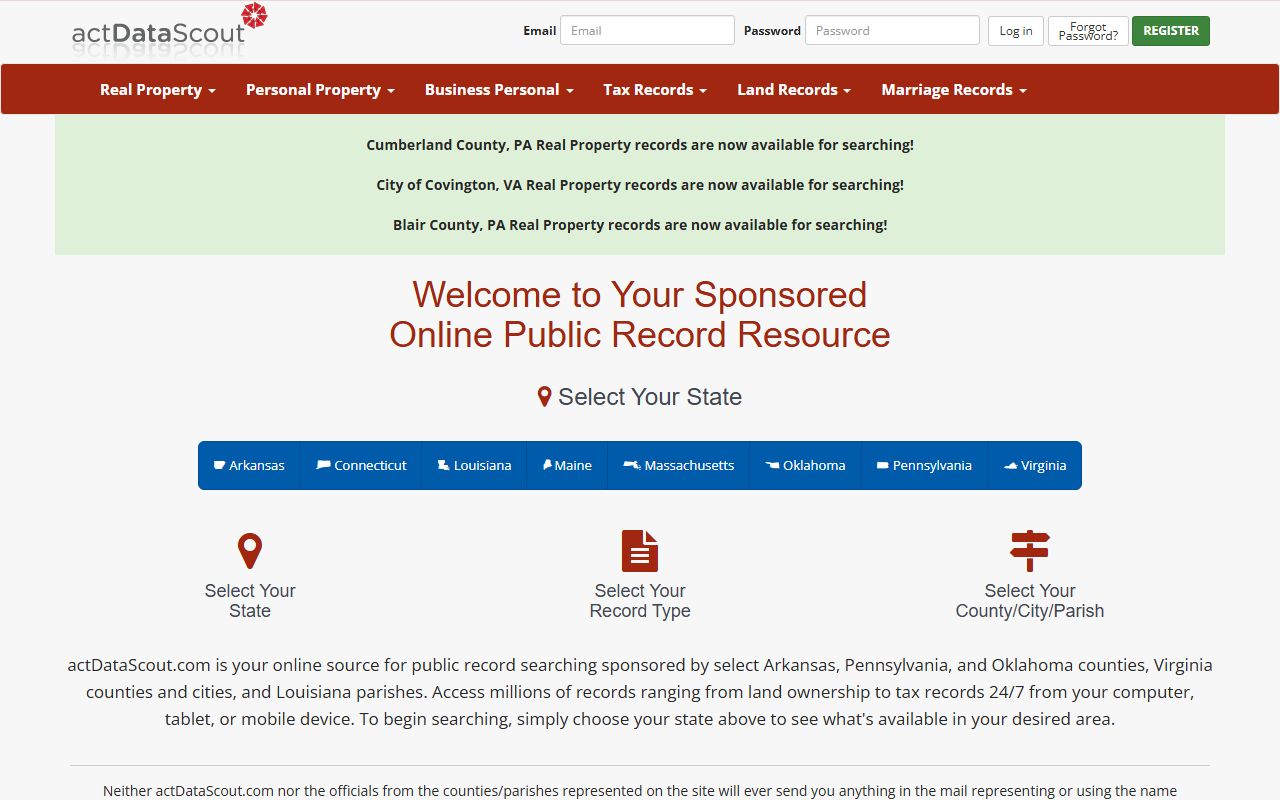
The fastest way to look up Cleveland County property tax records is through ActDataScout, the statewide search tool used by most Arkansas counties. You can search by owner name, parcel number, or property address.
ActDataScout pulls data directly from the assessor's records and shows assessed values, ownership history, legal descriptions, and in many cases the current tax status. The system is updated regularly and is free to use for basic lookups. Visit the Cleveland County search page at ActDataScout's Cleveland County portal to start your search. You can also use ARCountyData.com as an alternative source for Arkansas property data.
The ActDataScout portal for Cleveland County gives access to current assessments along with parcel maps and ownership records.
Note: Search results show assessed values, not market values. The assessed value is 20% of market value for all property classes in Arkansas.
How Cleveland County Assessments Work
Arkansas uses a uniform assessment rate across all counties. Every property is valued at 20% of its market value as of January 1 each year, as required by A.C.A. § 26-26-1201. So if your home has a market value of $150,000, the assessed value used to calculate your tax bill will be $30,000. The local millage rate is then applied to that assessed value to produce your annual tax bill.
Arkansas Amendment 79 provides some protection against rapid assessment increases. For homestead properties, the assessed value cannot increase more than 5% in a single year. For non-homestead property, the cap is 10% per year. These caps apply even when a full reappraisal would otherwise push the value higher. The cap resets to fair market value when the property is sold. This means buyers sometimes see a noticeable jump in their assessed value in the first year after purchase.
New construction is added to the rolls at full market value in the year it is completed. Improvements like room additions or new outbuildings are also factored in during the next assessment cycle. Owners who believe their assessed value is too high can file a formal appeal with the county equalization board. The assessor's office can explain the appeal process and deadlines.
Tax Bills and the October 15 Deadline
Cleveland County tax bills are mailed around July 1 each year. The deadline to pay without penalty is October 15, as set by A.C.A. § 26-35-501. Most homeowners pay in a single payment before that date. There is no discount for early payment, and there is no installment plan for most property types.
If you don't pay by October 15, the collector adds penalty and interest charges. The county publishes a delinquent tax list in December. That list names all property owners who still owe taxes from the prior year. Being on the delinquent list can affect your ability to renew vehicle tags and can lead to eventual tax sale proceedings if taxes remain unpaid.
The county collector's office handles all payments. You can contact the Cleveland County Collector for information on payment options and outstanding balances. The collector works separately from the assessor. The assessor sets values; the collector handles billing and collections.
For questions about payments or amounts owed, the Arkansas Association of Counties collector FAQ has general guidance that applies to all Arkansas counties including Cleveland.
Homestead Credit and Senior Freeze
Arkansas homeowners can apply for a homestead credit that reduces their property tax bill by up to $600 per year. This credit comes from Amendment 79 and applies to the primary residence only. You must own and live in the home to qualify. The application deadline is October 15.
Residents who are 65 or older or who have a qualifying disability may also be eligible for the senior assessment freeze. This program locks the assessed value of the homestead at the level it was when the owner first qualified. Even if the property is reappraised at a higher value, the frozen assessed value stays the same for tax purposes. This can result in significant savings over time, especially in areas where property values are rising. Contact the Cleveland County Assessor at (870) 325-6337 to ask about applying for the freeze or the homestead credit.
Delinquent Property and the Commissioner of State Lands
Property with unpaid taxes in Cleveland County eventually moves into the state's tax delinquency process. Under A.C.A. § 26-37-101, property that remains delinquent for more than one year can be certified to the Commissioner of State Lands (COSL). Once certified, the COSL takes over the process and can offer the property for sale to recover the owed taxes.
The Commissioner of State Lands website lets you search for certified delinquent properties by county. Investors and individuals looking to purchase delinquent land often start at the COSL site. The process involves a public auction or a direct sale through the COSL office. Buyers take the property subject to certain redemption rights that the original owner may exercise within a set period. Cleveland County properties that have been certified to the state show up in the COSL database and can be searched there at no cost.
Note: Owners have one year from certification to pay all back taxes, fees, and interest to reclaim their property before it is sold.
Recording Documents with the Circuit Clerk
Property-related documents in Cleveland County are recorded with the Circuit Clerk's office at (870) 325-6522. This includes deeds, mortgages, liens, and other instruments that affect title to real property. Recorded documents become part of the public record and are searchable through the clerk's office.
Arkansas has standard recording requirements. Documents must be on 8.5 by 11 inch paper, have a 2.5 inch top margin on the first page, and 0.5 inch margins on all other sides. The recording fee is $15 for the first page and $5 for each additional page. Documents that don't meet the formatting rules may be rejected or charged a non-standard fee. After a deed is recorded, the assessor's office is notified and will update the ownership records for the property. That update feeds into the tax records and affects who receives future tax bills.
Nearby Counties
Cleveland County borders several other Arkansas counties, each with its own assessor and property tax records.