
Arkansas County Property Tax Records
Arkansas County holds property tax records for all real and personal property located within its borders, maintained across two county seats in DeWitt and Stuttgart. The assessor, collector, and circuit clerk each play a distinct role in tracking property values, billing taxes, and recording deed transactions -- and this guide walks through what each office does, how to search records online, and what state law requires of property owners in Arkansas County.
Arkansas County Property Tax Overview
Arkansas County Assessor and Property Records
The Arkansas County Assessor is responsible for finding, listing, and placing a value on all taxable property in the county each year. Real property assessments run from January 1 through July 1, as set out in A.C.A. § 26-26-1101. Personal property -- vehicles, boats, business equipment -- must be assessed between January 1 and May 31 under A.C.A. § 26-26-1408. Missing that May 31 cutoff triggers a 10% late assessment penalty, so property owners need to act early in the year.
Arkansas County uses January 1 as the valuation date for all property, per A.C.A. § 26-26-1201. That means the condition and ownership of a piece of property on January 1 determines how it is taxed for that entire year. The assessed value is set at 20% of market value -- that's the statewide standard. So a home worth $150,000 on the market would carry an assessed value of $30,000, and the tax bill is calculated from that figure.
Arkansas County reappraises real property on a cycle of three to five years. Reappraisal brings assessed values into line with current market conditions. Amendment 79 of the Arkansas Constitution caps how much assessed value can rise per reappraisal cycle: 5% for homestead properties and 10% for non-homestead properties. This cap gives homeowners some predictability even in fast-moving markets.
Historical property tax records for Arkansas County stretch back to 1818. Tax lists from 1818 through 1895 have been preserved through archival sources. These older records can be useful for genealogical research, estate matters, or tracing the chain of title on older parcels.
Search Arkansas County Property Tax Records Online
Arkansas County participates in the ARCountyData online property search portal, which provides free public access to county property tax data. The collector's office sponsors this free public search, making it one of the more accessible county systems in the state.
The ARCountyData portal lets you look up property records by owner name, parcel number, or property address. You can view assessed values, tax history, payment status, and other key details without visiting either courthouse in person. This is the fastest way to get basic information about any parcel in Arkansas County.
See the ARCountyData portal for Arkansas County property records below.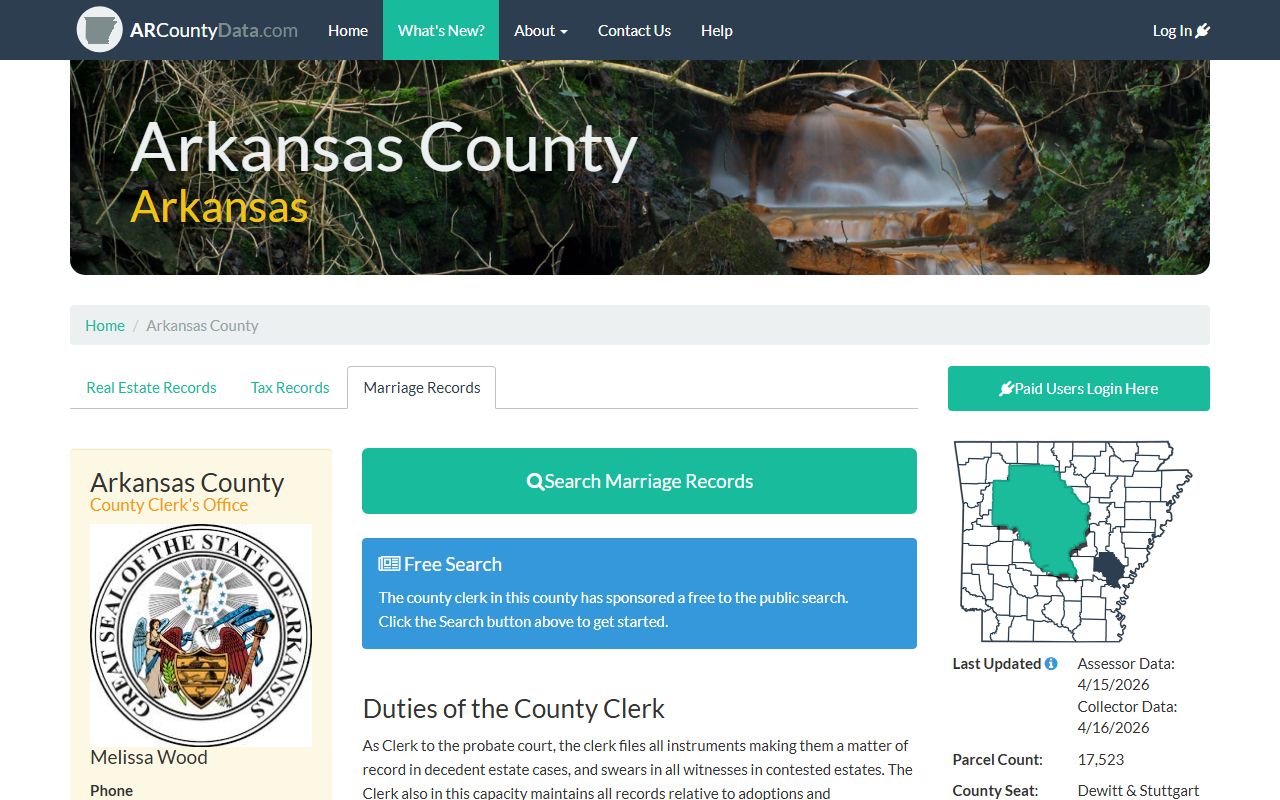
For users who need more detailed data or want to cross-reference parcel records with GIS layers, ACTDataScout is another statewide tool worth checking. It pulls assessor and collector data for most Arkansas counties and lets you search by address, owner name, or parcel ID. Between the two platforms, most questions about Arkansas County property can be answered without a trip to the clerk's office.
Note: Online records may have a short lag compared to what's recorded at the courthouse, so always confirm critical details directly with the county office.Tax Collection Deadlines and Delinquent Property
Property taxes in Arkansas County are due by October 15 each year, as required by A.C.A. § 26-35-501. The collector's office mails tax bills by July 1, which gives property owners more than three months to pay. Payments can typically be made in person at either county seat, by mail, or online through the payment system linked on the county's website.
If taxes remain unpaid after October 15, the property owner's name appears on the delinquent list published around December 1. This list is published at the owner's expense -- there is a $1.50 per tract publication fee that gets added to the delinquent account. After a period of continued non-payment, the property becomes eligible for transfer to the state land commissioner.
Delinquent properties in Arkansas County that go unsold at the county level are turned over to the Commissioner of State Lands (COSL). The COSL manages these parcels and makes them available for purchase or redemption. Property owners have a right to redeem delinquent land by paying all back taxes, penalties, interest, and fees before a third party purchases the parcel. Under A.C.A. § 26-37-101, this redemption window is generally one year from the date of the delinquency action. The COSL website lists all properties currently in the state's inventory.
Circuit Clerk and Property Document Recording
The Arkansas County Circuit Clerk records deeds, mortgages, liens, plats, and other instruments affecting real property. Recorded documents become part of the public record and establish the legal chain of title for each parcel in the county. Anyone researching a property's ownership history -- buyers, lenders, attorneys, or title companies -- relies on these records.
Recording fees follow the statewide schedule: $15 for the first page of any document and $5 for each additional page. Documents submitted for recording must be on 8.5x11-inch paper, with a 2.5-inch top margin on the first page and at least 0.5-inch margins on the sides. Documents must also be properly acknowledged (notarized) before they can be accepted. Submitting a document that doesn't meet these standards will result in rejection, so it's worth double-checking formatting before bringing anything in.
The clerk's office maintains grantor-grantee indexes that let you trace ownership of a parcel over time. These indexes can be searched by party name. For older documents, some records may be available only through in-person review at the courthouse.
Note: Arkansas County has two courthouse locations -- one in DeWitt and one in Stuttgart -- so confirm which office handles your specific transaction before making the trip.Homestead Tax Credit and Exemptions
Arkansas homeowners can apply for the homestead property tax credit under Amendment 79 of the Arkansas Constitution. This credit reduces the net property tax bill by up to $600 per year on a qualifying primary residence. To get the credit, you must apply at the assessor's office by October 15 of the tax year. The credit applies only to the property where you live -- not rental units, vacant land, or business property.
Seniors and people with disabilities may qualify for an additional benefit: the assessed value freeze. If you are 65 or older, or permanently and totally disabled, and meet income limits, the taxable value of your homestead can be frozen at its current level. That means even if the market value of your home rises, your property tax bill stays the same. This freeze must also be applied for at the assessor's office, and it does not happen automatically.
The Arkansas Assessment Coordination Division within the Department of Finance and Administration oversees the rules for assessments and exemptions statewide. If you have questions about whether your property qualifies for a credit or freeze in Arkansas County, contacting both the local assessor and the ACD can help clarify your situation.
Arkansas County Tax Records History
Arkansas County is one of the oldest counties in the state, and its tax record history reflects that. Property tax records from as far back as 1818 have been preserved, making this county particularly useful for historical research. Tax lists from 1818 through 1895 document property ownership and assessed values across many decades of county history. Researchers can access these records through archival sources and some digitized collections.
For those researching old land records in Arkansas County, the circuit clerk's grantor-grantee index is a key starting point. Older deeds and instruments recorded in the 1800s may require in-person visits to review microfilm or paper files. The Arkansas Association of Counties provides general guidance on how property records and tax collection work across the state, which can help orient researchers who are new to Arkansas public records.
Nearby Counties
Arkansas County borders several counties in the Arkansas Delta and Grand Prairie regions.